
Is Time Just an Illusion We Use to Measure Spatial Change?
On this page
"Thời gian chỉ là một khái niệm con người tự định nghĩa ra để ám chỉ sự thay đổi của không gian." (Time is merely a human-defined concept used to imply the change of space.)
I recently saw a few friends' posts complaining about time, and I just had a thought: time is just an illusion to help us imagine and describe spatial change. We are conditioned to feel time passing like a relentless river, carrying us from the past into the future. But if we strip away human perception and look strictly at how the universe works, does "time" actually exist?
Or is it just a tool we invented to track things moving around in space?
Why Did We Invent Time?
So why and when did humans actually start using this concept?
It started the moment early humans needed to predict the future. When our ancestors transitioned from nomadic hunter-gatherers to settled farmers, they realized that the space around them was changing in massive, predictable cycles. The sun's path across the sky shifted higher or lower, and specific constellations appeared right before the weather turned cold or the rains began.
To survive, they needed a way to track these massive spatial shifts so they knew exactly when to plant seeds and harvest crops. They didn't discover a flowing river of "time"—they simply recognized the repetitive motion of the Earth and stars, and invented the concept of "seasons" and "calendars" to keep track of that movement. We also invented tools to measure these concepts, which we called 'time'.

From that moment of realization onward, every tool we built to measure time was actually just a tool to measure space:
The Ancient Sky: When ancient civilizations built the first sundials, they weren't capturing invisible time passing; they were measuring the physical shadow cast by the Earth spinning on its axis. "A day" was just the completion of a spatial rotation.
Mechanical Clocks: In the Middle Ages, we invented gears, springs, and pendulums to break the day down into smaller, more useful chunks. But a grandfather clock only ticks because a physical pendulum swings back and forth through the air, and gears physically rotate inside a wooden box. (Fun fact: nowadays, lots of people love to wear mechanical watches because of their vintage style and the classic "tick" sound!)
Atomic Clocks: Today, our most precise timekeepers are atomic clocks, which dictate global GPS and computer networks. But even these don't measure pure time. They measure the exact frequency of radiation emitted when electrons physically jump between energy levels in a Cesium-133 atom.


Throughout all of human history, from the first agricultural calendars to modern quantum mechanics, we have only ever measured matter changing its configuration in space—and we universally agreed to call that measurement "time".
The Flipbook
Imagine a universe where absolutely nothing moves. Every atom, every beam of light, and every planet is completely frozen. In a universe like this, would time still pass?
Many philosophers of physics argued that the answer is no. They proposed that time does not exist on its own; it is simply the relationship between physical events [1]. Think of the universe like a flipbook. A single page doesn't contain "movement" or "time." Time only emerges when you flip the pages and see things change from one frame to the next. When we say "one second has passed," we aren't capturing a piece of invisible time. We are just measuring a physical change in space—like the ticking of a clock's gear or the vibration of an atom.

The Arrow of Time
If time is just a way to measure change in space, why does it only seem to go in one direction? Why can't we un-spill a glass of milk or un-melt an ice cube?
The answer lies in a concept called entropy. In physics, entropy is the natural tendency for things to go from a state of order to a state of messiness or disorder [2]. Think of an intact ice cube: it is highly ordered. A puddle of water, however, is messy and disordered. There are trillions of ways for water molecules to form a messy puddle, but only one specific way for them to lock together into a perfect ice cube.
We actually experience this in our everyday lives through something called Murphy's Law:
"Anything that can go wrong will go wrong."
From a physics perspective, Murphy's Law isn't bad luck—it is literally just entropy in action. For a device to run smoothly or for your desk to stay neat*, everything has to line up just right. But there are endless ways for things to break down or get messy.
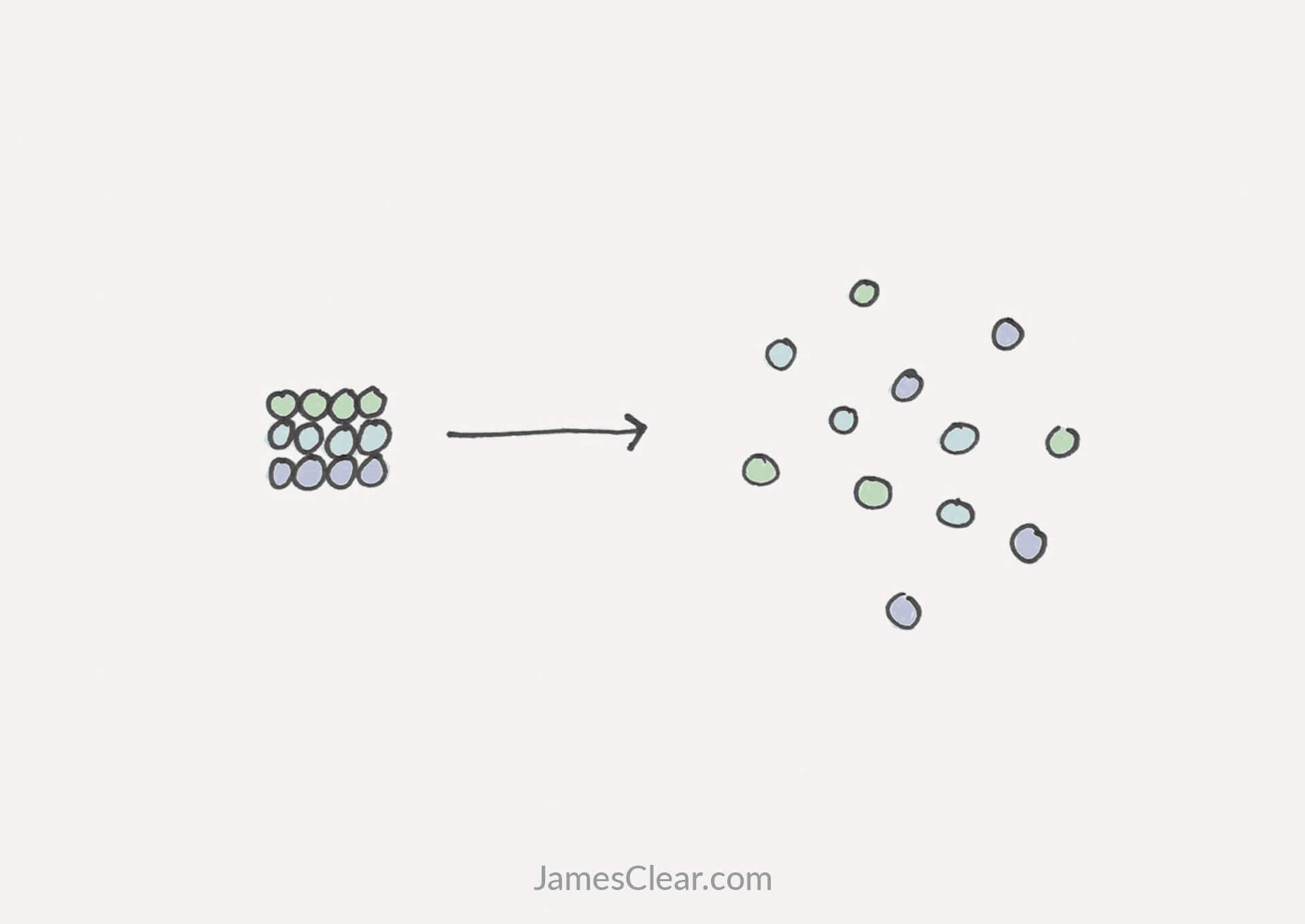
from a state of order to a state of messiness or disorder
Because there are so many more ways to be messy than to be perfectly organized, the universe statistically always moves toward disorder. What we experience as the "forward flow of time" is really just the universe rearranging its space from a less probable state (order) to a more probable state (messiness). The "arrow of time" is not a property of an invisible clock; it is just a statistical property of matter rearranging itself in space.
The Harshness of the Arrow of Time
From everything we have discussed above, we must face a harsh realization: with our current understanding of the universe, we can never go back to undo what has already happened. We cannot un-break a shattered vase, and we cannot reverse time to speak to a person who has already passed away.
Entropy demands that the universe moves forward, never backward. This means that every single arrangement of space, every fleeting interaction, and every shared experience is unique and temporary. Because we cannot reverse the flow of disorder, we must cherish every moment we have. Once that specific configuration of time and space has passed, we may never get to experience it again.
References:
[1] Fortin, S., Lombardi, O., & Pasqualini, M. (2021). Relational event-time in quantum mechanics. Foundations of Physics, 52.
[2] Ben-Naim, A. (2020). Entropy and time. Entropy, 22(4), 430.
Get new signals by e-mail
A short note when something new is published. No noise, and you can leave with one click.
More signals

Understanding the Singleton Pattern: From Core Concept to Thread-Safe Java
Discussion